Specify the exposure
The sponsor defines covered perils, geography, risk period, attachment, limit and trigger. In a common structure, a special-purpose vehicle issues notes and provides protection.
MOLTO RE / INSURANCE LINKED SECURITIES
Insurance-linked securities connect defined insurance exposures with investor capital. Catastrophe bonds are one part of that market, and a complementary source of protection alongside traditional reinsurance.
Explore market performance ↓MARKET PERFORMANCE
Compare US equities, US insurance-company stocks and available catastrophe bond benchmarks. KIE represents insurance equity ownership; it does not measure the return on a traditional reinsurance treaty.
Loading verified annual returns…
Market update status is loading…
INSURANCE-LINKED SECURITIES / PLENUM

The Plenum CAT Bond UCITS Fund Indices track the total returns of UCITS funds investing directly in catastrophe bonds. They use selected accumulating, currency-hedged fund share classes and their net asset values (NAVs), with one eligible share class per fund. The USD family compares the broad market with higher- and lower-risk fund groups, alongside an asset-weighted view. The full history begins in January 2011, with monthly historical observations followed by weekly live observations. Plenum currently calculates and publishes the indices weekly. These observations represent fund NAV performance rather than executable trading prices.
Index provider and owner: Plenum Investments AG. For informational and comparative purposes only. Past performance is not a reliable indicator of future results. Read Plenum’s full index disclaimer (PDF).
Loading Plenum history…
Loading ILS Advisers history…
THE ASSET CLASS
Insurance-linked securities, or ILS, link investment outcomes to specified insurance risks. Catastrophe bonds transfer exposures such as hurricanes and earthquakes. The broader alternative-capital market also includes collateralized reinsurance, sidecars, and structures linked to life or other insurance risks.
Investors receive compensation for bearing defined risks. A qualifying loss can reduce or exhaust their principal. For sponsors, including insurers, reinsurers, governments and corporations, these structures can diversify protection capacity and complement a broader risk-financing program.
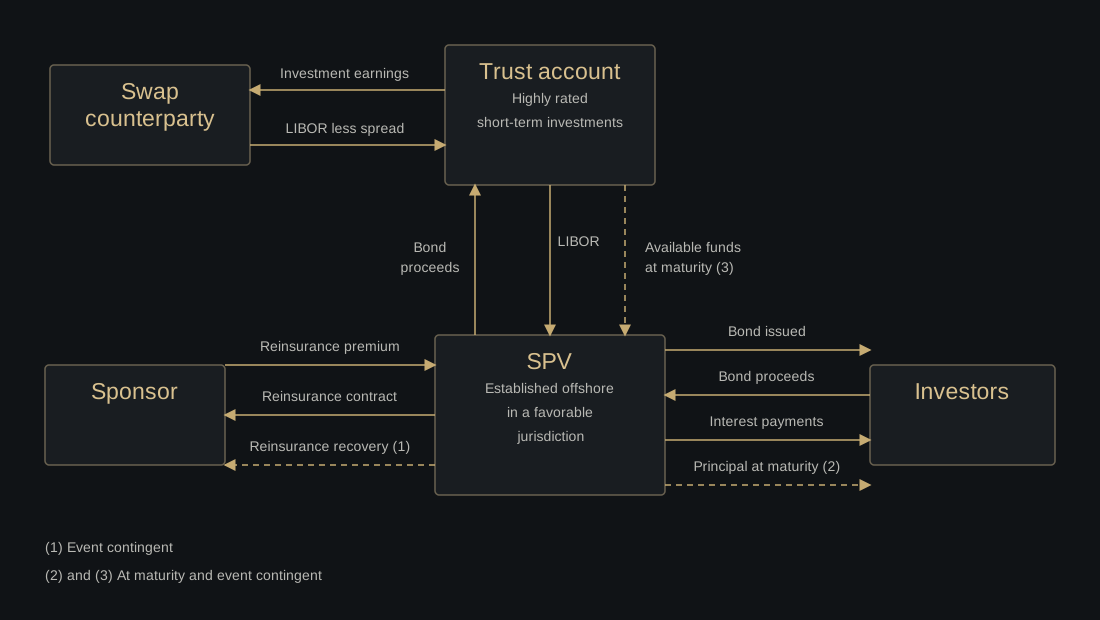
Recreated from Figure 3 in Bobby E. Bierley, James I. Hilliard and Robert E. Hoyt, Catastrophe Securitization: A Multi-Factor Event Study on the Corporate Demand for Risk Management, p. 9. The original credits Cummins (2008), McGhee et al. (2007), and Wattman and Jones (2007).
This historical structure uses LIBOR and a swap counterparty, as shown in the paper. Collateral arrangements and reference rates vary by transaction. Dashed arrows indicate payments contingent on the event and contractual terms.
HOW A CAT BOND WORKS
The sponsor defines covered perils, geography, risk period, attachment, limit and trigger. In a common structure, a special-purpose vehicle issues notes and provides protection.
Investors fund the notes. Collateral is typically invested in high-quality assets. Investor coupons generally combine collateral income with the insurance risk premium.
If the trigger is met, some or all of the principal can fund the sponsor’s recovery. Otherwise, remaining principal is returned at maturity, subject to the terms and any extension.
TWO SOURCES OF CAPACITY
These markets overlap: a cat bond can fund a reinsurance agreement. The comparison below focuses on traditional balance-sheet reinsurance and catastrophe bonds, rather than treating every ILS structure as identical.
| Dimension | Traditional reinsurance | Catastrophe bonds / ILS |
|---|---|---|
| Source of capital | A reinsurer’s balance sheet, supported by its capital and risk management. | Capital-market investors supply collateral through a defined transaction. |
| Risk transferred | Treaties or facultative contracts can cover many classes, layers and loss patterns. | Cat bonds typically cover specified catastrophe perils, regions and contractual loss layers. |
| Contract term | Commonly renewed annually; multiyear arrangements also exist. | Frequently multiyear protection, subject to deal-specific terms and possible extensions. |
| Funding & counterparty exposure | Claims depend on the reinsurer’s ability to pay; collateral requirements vary. | Typically prefunded collateral reduces counterparty exposure, but collateral, legal and operational risks remain. |
| Payout trigger | Commonly follows the cedent’s covered losses under the contract. | May use indemnity, industry loss, modelled loss or parametric triggers. |
| Flexibility & cost | Bilateral negotiation can accommodate tailored coverage and ongoing relationships. | Issuance requires modelling, legal documentation and investor placement; fixed costs matter. |
| Liquidity for the risk bearer | Reinsurance contracts generally are not exchange-traded investments. | Cat bonds can trade in a secondary market, but liquidity may weaken sharply after events. |
TRIGGERS & BASIS RISK
Based on the sponsor’s covered losses. Close alignment with the underlying exposure can come with longer claims development and settlement.
Based on an independent estimate of covered industry losses. The sponsor’s own losses can differ from the industry measure.
Based on measured event characteristics, such as earthquake magnitude or wind speed. Potentially faster assessment, with a risk that payment differs from actual loss.
Based on a defined model’s estimate of loss from an event and specified exposure data. Outcomes depend on model assumptions and contract terms.
Coverage can respond to a single occurrence or aggregate losses across a risk period. A disaster alone does not guarantee a payment: the defined trigger and contractual conditions must be satisfied.
READING THE INDICES
Swiss Re Global (SRGLTRR) and USD (SRCATTRR) total return indices measure baskets of catastrophe bonds using indicative prices and coupon returns. Plenum’s USD Average (PLCBFUA) measures cat bond UCITS funds, so fund expenses, management choices and portfolio composition distinguish it from a direct bond index.
RISK PERSPECTIVE
Insurance events have different drivers from corporate earnings, but low historical correlation is not guaranteed. Cat bond investors face principal loss, catastrophe-model uncertainty, concentration, collateral risk and limited liquidity. Indicative valuations may understate changes in executable market prices.